
The Ultimate Guide to Custom Shopify Development for Rapid Scaling
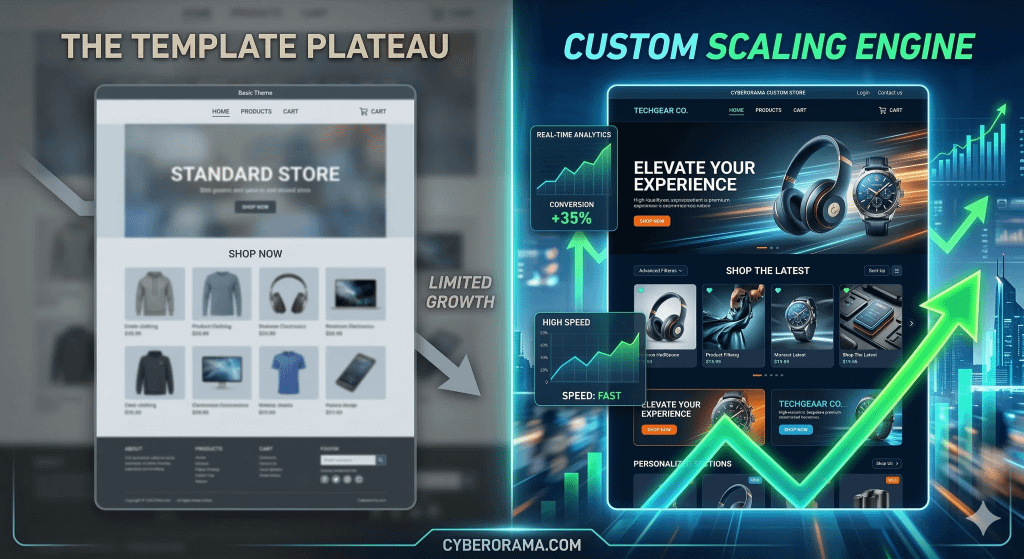
The Ultimate Guide to Custom Shopify Development for Rapid Scaling
Beyond the Template Trap: The Ultimate Guide to Custom Shopify Development for Rapid Scaling
The initial rush of launching an e-commerce store is undeniable. You’ve got your products, your first few sales, and you are officially in business. If you are reading this, there is a strong chance you built that initial store on Shopify using a pre-packaged theme and perhaps 10 to 15 apps to manage standard functions.
This approach is excellent for the “startup” phase. It minimizes initial capital investment and gets you to market quickly.
But something changes when you hit a specific threshold. Maybe you reach $250k, $1M, or $10M in annual revenue. The tools that got you here are no longer capable of getting you to the next level. Your growth plateaus. Your customer experience feels fragmented. Your site feels sluggish.
You are stuck in the “Template Trap.”
In this comprehensive guide, we will explore why standard themes and app reliance are common growth bottlenecks. We will break down exactly how custom Shopify development is the strategic lever needed to unlock explosive e-commerce scaling, improve conversion rates, and build a truly resilient, future-proof business.
Part 1: Diagnosing the Stagnation: Why Your Basic Shopify Store is Costing You Money
When you are fighting for market share against giants, “good enough” is a dangerous state of mind. Many merchants don’t realize that their reliance on out-of-the-box Shopify solutions is actively harming their profitability.
Here is a look at the critical symptoms that indicate you’ve outgrown your current setup.
1. The “Me Too” Brand Crisis
If you are using a top-five theme from the Shopify Theme Store, you are sharing your design DNA with tens of thousands of other merchants. It is incredibly difficult to build a high-end, premium brand identity when your storefront looks and functions exactly like your competitor’s.
In a hyper-competitive landscape, differentiation is currency. A generic customer experience results in generic brand loyalty. To command premium prices and build customer equity, you must offer an experience that is uniquely yours.
2. Performance Paralysis: The Danger of “App Bloat”
The easiest way to add a feature to a basic Shopify theme is by installing a third-party app. Need product reviews? Install an app. Need tiered pricing? Install another app. Need a countdown timer? Install a third one.
While easy to install, this reliance on external apps creates a highly fragile architecture. Here is what happens under the hood:
- Excess JavaScript Payloads: Every app injects its own JavaScript library into your storefront. When a customer lands on your page, their browser is forced to download, parse, and execute dozens of competing scripts.
- Asset Conflicts: Apps often conflict with one another, causing mysterious visual glitches or feature failures.
- Slower Core Web Vitals: Google uses Core Web Vitals (like Largest Contentful Paint) as a ranking factor. If your site is bogged down by excessive JavaScript from apps, your search rankings will suffer, increasing your reliance on expensive paid ads.
3. Friction-Filled Customer Journeys
Templates are designed for generality. They are built to work for a T-shirt company and a high-end furniture store. This means they are optimal for neither.
If your product requires a specific type of personalization, complex bundling, dynamic pricing models, or a unique “subscription and save” workflow that isn’t native to the theme, you are introducing friction. Every click, reload, or unexpected behavior in the buyer’s journey increases the likelihood of cart abandonment.
4. Limited Backend Workflows
Standard themes focus on the customer-facing frontend. But as you scale, the backend workflows become critical. A growing store requires deep integration with other mission-critical software: ERPs (Enterprise Resource Planning), PIMs (Product Information Management), CRMs (Customer Relationship Management), and bespoke logistics providers.
When you hit a scaling plateau, your operations team often finds themselves doing massive amounts of manual data entry because the basic Shopify environment doesn’t offer the robust API integrations necessary for true automation.
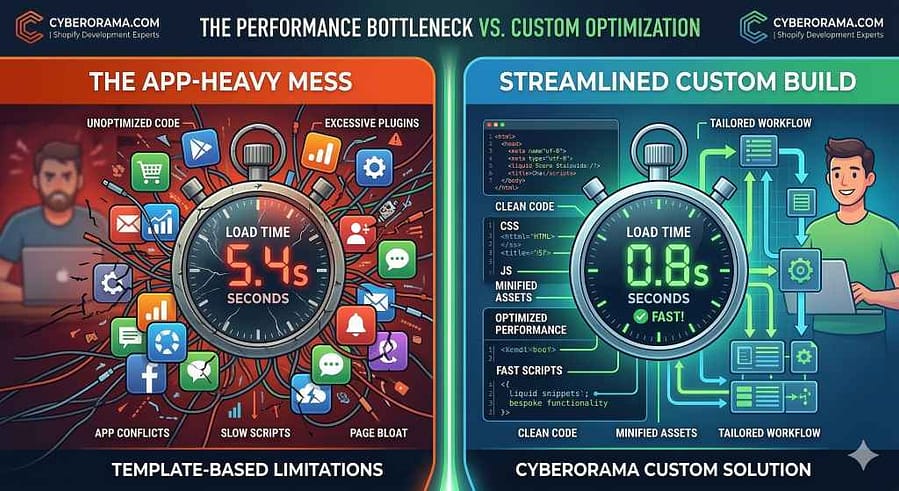
Investing in custom Shopify development is not a cosmetic upgrade; it is a strategic business decision focused on high ROI. It involves replacing generic logic and theme bloat with precision engineering.
When done correctly by a specialist agency like Cyberorama, custom development transforms your store from a cost center into a powerful revenue-generation engine.
1. Uncompromising, Optimized Speed and Technical Performance
Speed is your number one competitive advantage in e-commerce. It impacts everything: conversion rates, average order value, search engine visibility, and brand perception. According to numerous studies, even a one-second delay in page load time can reduce conversions by over 7%.
Custom development allows you to build your storefront from scratch, prioritizing performance at every step.
Clean Codebase: By writing bespoke Shopify Liquid and JavaScript, we remove all the generic features you don’t use that are native to themes. We load only what is essential, when it is essential.
Optimization: Developers can implement advanced image optimization, lazy loading, script prioritization, and asset minification that templates are incapable of achieving out-of-the-box.
The result is a lightning-fast experience that keeps users engaged, reduces bounce rates, and signals to Google that your site is authoritative.
2. Advanced Conversion Rate Optimization (CRO)
Your customer experience should be engineered specifically around your audience and your products. Custom development allows us to analyze your customer data and build a unique UI/UX designed specifically to eliminate buying resistance.
Tailored Product Pages: We can create dynamic product pages that change based on user behavior, product type, or traffic source. This includes interactive product configurators (e.g., choosing colors, materials, engravings with real-time visualization).
Dynamic Upselling and Cross-Selling: Forget basic “You Might Also Like” carousels. Custom code can generate hyper-relevant bundling and upselling opportunities based on deep data analysis of what customers actually buy together, presented seamlessly in the cart or on the product page.
Frictionless Checkout Flows: While the final checkout page on Shopify is standardized (unless on Shopify Plus), the entire flow before that (cart drawers, mini-carts, account registration) can be customized to minimize the steps to purchase.
3. Limitless Brand Identity and Digital Experience
Your online store is your digital flagship. It needs to convey authority, trust, and premium status immediately. Custom development grants complete creative freedom.
Bespoke Interactions: We can implement smooth, premium micro-animations that guide the user’s eye to key actions (like ‘Add to Cart’).
Unique Narrative Layouts: For brands whose value proposition requires storytelling, we can build unconventional layouts that weave product details with brand history and social proof, rather than just forcing products into a standard grid.
Interactive Content: Think interactive fit guides, complex size charts, or quizzes that recommend products, all built into the theme architecture rather than being a slow, external app.
4. Scalable, Robust Architecture via Integrations
As you grow, Shopify should become the central hub of your operations, not an island. Custom development connects your storefront to the rest of your business ecosystem.
API and Middleware Development: We build robust API connections to sync real-time inventory with warehouse systems (like NetSuite or Linnworks), push customer data into specialized CRM platforms (like Salesforce or HubSpot), and automate order fulfillment tracking across multiple carriers.
Custom App Development: Sometimes, a problem is so unique that no public app exists to solve it. In these cases, we build private, custom Shopify apps that reside in your store and provide the specific functionality you need without the performance drag of public apps.
This level of automation eliminates manual errors, slashes operational overhead, and ensures that your business can double or triple its order volume without breaking the workflow.
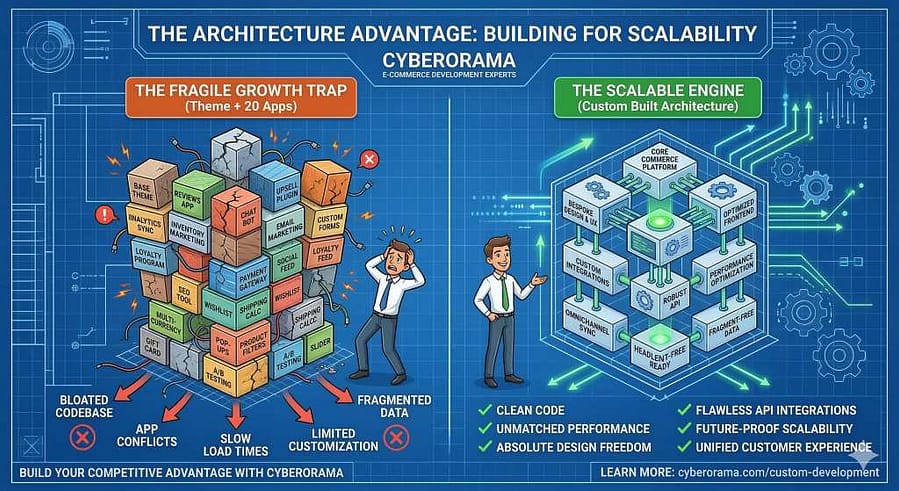
Part 3: Mastering Advanced Shopify Solutions: Headless and Beyond
For high-volume merchants aiming for the absolute pinnacle of performance and flexibility, standard Shopify architecture (even with custom Liquid development) may have its limitations. This is where advanced solutions come into play.
The Rise of Headless Commerce with Shopify
Headless commerce is the process of decoupling the frontend presentation layer (the website your customers see) from the backend commerce layer (the admin panel where you manage products, orders, and customer data).
In a Headless Shopify setup, you still use Shopify for its robust backend capabilities (cart functionality, payments, inventory), but you build the frontend using modern JavaScript frameworks like React, Vue.js, or Svelte.
Benefits of Headless Shopify:
Instantaneous “App-like” Performance: Headless websites function more like mobile applications. Pages load instantly without full-page reloads, providing a smoothness that is unmatched by traditional themes.
Omnichannel Consistency: Because the backend is “decoupled,” you can deliver the exact same product information, pricing, and content to a custom website, a native mobile iOS application, an in-store kiosk, or even Jumbotron displays, all controlled from the central Shopify admin.
Ultimate Creative Freedom: Without the constraints of Shopify’s Liquid templating language, developers have zero limitations on what they can build for the frontend, enabling truly immersive, experiential commerce.
While powerful, Headless Commerce is not for every store. It requires significantly higher initial investment and specialized maintenance. This is why a strategic partnership with a skilled agency like Cyberorama is essential to determine if this is the right move for your growth stage.
Beyond Headless: Specific Custom Use Cases
Custom development often means solving hyper-specific niche challenges. Here are real-world examples of projects we develop:
Complex B2B Wholesale Portals: Building separate storefronts or login experiences for wholesale clients, allowing dynamic pricing based on client tier, quantity-based discounts, specific payment terms (e.g., Net-30), and easy “quick-add” ordering interfaces.
High-End Subscription Models: Customizing “subscribe and save” flows to offer gifts, dynamic delivery frequencies, and easy subscription management dashboards that are intuitive and brand-aligned, far surpassing standard app offerings.
Localized Internationalization: Deeply integrating localized pricing (not just currency conversion), multi-warehouse inventory sourcing, and localized marketing content tailored to specific regions, all managed from a single Shopify setup.
Part 4: Partnering for Success: How to Choose a Custom Shopify Development Agency
You’ve decided that custom development is the next step. Now comes the most critical choice: who do you trust to build your scaling engine?
This is not a project to trust to a generalist web design firm. Shopify is its own ecosystem with unique nuances, API behaviors, and liquid syntax. You need a dedicated Shopify development specialist.
What to Look for in a Shopify Partner:
1. Proven Portfolio and Case Studies
Don’t just look for pretty pictures. Demand detailed case studies that outline the results of their work. A reputable agency will show you concrete data: “We reduced page load time by 45%, resulting in a 12% increase in conversion rate.” Look for projects similar to your complexity.
2. Strategic Thinking, Not Just Technical Ability
Your developers shouldn’t just be ticket-takers. They must be strategic partners. They should ask probing questions about your business goals, target customer, operational bottlenecks, and average order value. A great developer understands e-commerce strategy, not just code syntax.
3. Deep Knowledge of Integrations and APIs
The complexity of e-commerce scaling is managed via data flow. Your agency partner must demonstrate profound understanding of Shopify’s Admin API, Storefront API, and Liquid language, and show experience integrating complex third-party enterprise software (ERPs, CRMs).
4. The Discovery and Post-Launch Process
Be wary of agencies that immediately start coding. The best agencies utilize a rigorous Discovery phase to map out every requirement, user flow, and technical integration before a single line of code is written. Also, inquire about post-launch support and optimization retainers; your website is a living tool, not a static monument.
Conclusion: The Final Takeaway—Invest in Your Scalability
Relying on out-of-the-box Shopify solutions is excellent for hitting the ground running. However, as your store grows, the inefficiencies of templates, the fragility of “app bloat,” and the limitations of generic design become an existential threat to your scaling ambitions.
Custom Shopify development is the process of building the precise, high-performance machinery your business needs to break through its growth ceiling. It slashes your page load times, optimizes your conversion rates, integrates your operations, and establishes a premium brand experience that templates cannot replicate.
The investment in custom development is an investment in your company’s long-term resilience and profitability.
Ready to Escape the Template Trap?
At Cyberorama, we specialize in transforming standard Shopify stores into robust, high-performance scaling engines. We don’t just build websites; we engineer revenue accelerators. We understand the specific technical requirements and strategic nuances necessary to help high-growth merchants scale their business effectively.
Stop losing sales to slow speeds and generic experiences. Let’s talk about building the storefront your brand deserves.
[Click here to schedule your free, zero-obligation e-commerce strategy session with the Cyberorama team today.] Let’s discuss your current bottlenecks and map out a bespoke development plan to accelerate your growth.

Recent Posts

How Much Does It Cost to Hire a Web Developer in 2026?

